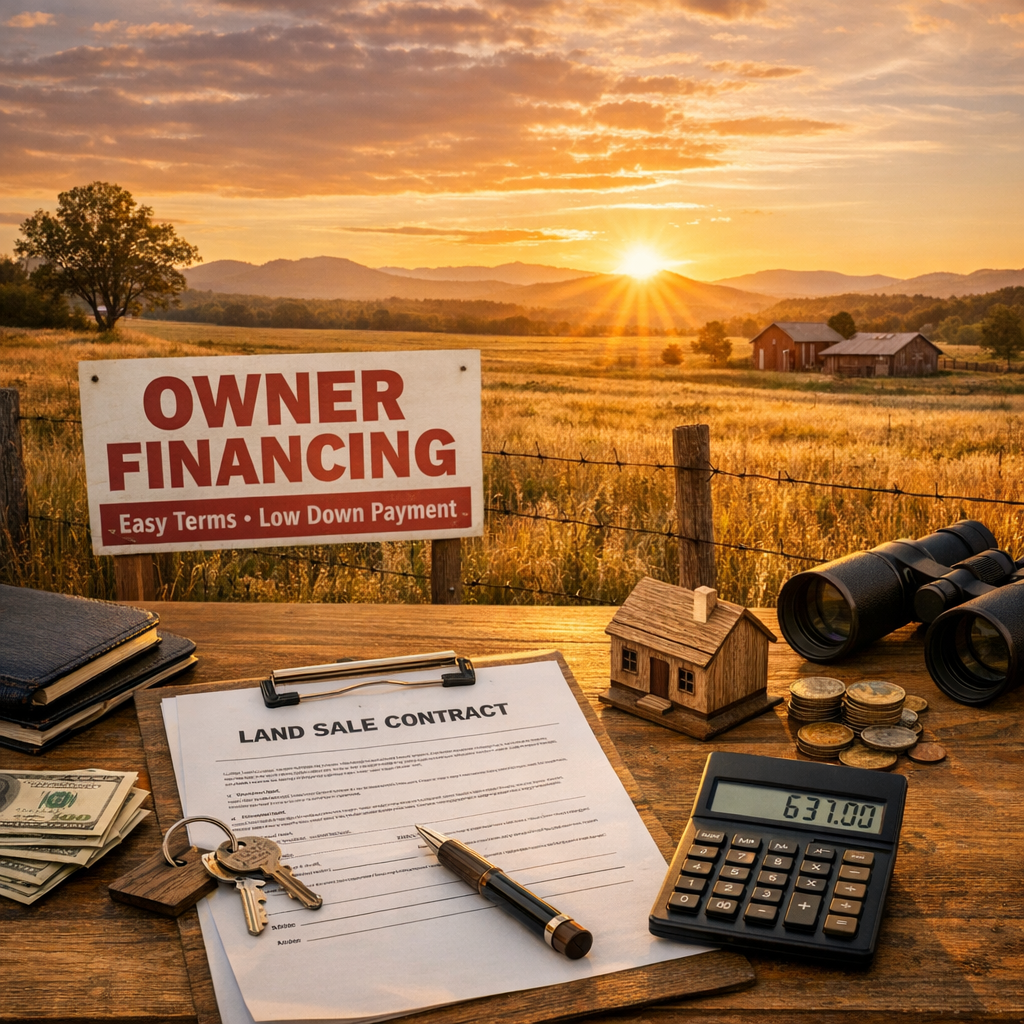
Owner‑Financed Land: How the Process Works
Owner financing has become one of the most practical ways to buy rural land, especially in the western states where banks tend to treat vacant acreage like an exotic risk. If you’ve ever tried to get a traditional land loan, you already know the drill: high down payments, short terms, strict underwriting, and interest rates that feel like a penalty for wanting open space.Owner financing cuts through all of that. It’s simple, direct, and built around an agreement between two people instead of a stack of institutional requirements. But simplicity doesn’t mean vagueness. Owner‑financed land deals follow a predictable structure, and understanding that structure helps buyers make smart decisions.
Typical Terms You’ll See
Most owner‑financed land agreements fall somewhere between three and ten years. Five years is common — long enough to keep payments manageable, short enough that the seller isn’t tying up the property forever. Some sellers stretch to fifteen years, especially on larger parcels, but shorter terms are the norm.The down payment varies with the property and the seller’s comfort level, but you’ll usually see something between ten and twenty percent. Sellers want enough skin in the game to feel confident the buyer is committed. Buyers appreciate that the down payment is still far lower than what a bank would demand for raw land, which often runs closer to thirty or forty percent.
Interest rates tend to land in the seven to twelve percent range. That might sound high compared to a home mortgage, but land is a different animal. There’s no structure to collateralize, no rental income to offset risk, and no federal programs backing the loan. Owner financing reflects that reality. The trade‑off is flexibility: you’re not dealing with credit committees, debt‑to‑income ratios, or underwriting delays. You’re dealing with a seller who wants the deal to work.
The Real Numbers Behind the Deal
Owner financing has a reputation for being simple, and it is — but it’s not vague. These deals follow patterns. Sellers want security. Buyers want access. Somewhere in the middle is a structure that has worked for decades, especially for vacant land where banks tend to hesitate. If you’ve ever wondered what owner financing really looks like in practice — the down payments, the interest rates, the monthly payments — here’s the straightforward version.Typical Terms You’ll See
Most owner‑financed land agreements run between five and ten years. Five years is the most common because it keeps the seller’s risk contained while giving the buyer enough time to pay off a modest parcel without feeling squeezed.Down payments usually fall between ten and twenty percent. Sellers want enough commitment to feel confident the buyer won’t walk away after a few months. Buyers appreciate that it’s still far less than the thirty to fifty percent banks often require for raw land.
Interest rates tend to land in the eight to twelve percent range. Land is considered higher risk than a home, the terms are shorter, and owner financing reflects that. The trade‑off is flexibility: you’re not dealing with underwriting departments or credit scoring formulas. You’re dealing with a seller who wants the deal to work.
What Those Numbers Actually Look Like
Take a $35,000 parcel — a common price point for rural acreage.With a 15% down payment, you’d put $5,250 down and finance the remaining $29,750.
On a five‑year term at 10% interest, the monthly payment comes out to roughly $631. Over the life of the loan, you’d pay about $37,860 in total payments, including interest.
Stretch the same loan to seven years and the payment drops to around $495 a month, though you’ll pay more interest over time.
If the seller prefers a shorter term — say, three years — the payment jumps to about $960 a month. That’s the trade‑off: shorter terms mean less interest but higher monthly commitment.
These aren’t hypothetical numbers. They’re the kind of terms you’ll see again and again in real owner‑financed land deals.
How Payments Are Handled
Some sellers collect payments directly, but many use a third‑party loan servicing company. The servicer handles the monthly payments, tracks the balance, keeps the records clean, and issues year‑end statements. It protects both sides and keeps the relationship simple.The agreement itself is usually structured as a promissory note paired with a deed of trust or land contract. The seller holds the title until the final payment is made. Once the contract is fulfilled, the deed transfers and the land becomes fully yours.
What Happens If a Buyer Defaults
Default isn’t common, but it’s part of the structure. Because the seller retains title during the contract period, they have a clear path to reclaim the property if payments stop. The exact process depends on state law, but it’s generally faster and less complicated than a traditional mortgage foreclosure.For buyers, the best approach is communication. Most sellers would rather adjust terms than start over. For sellers, the structure provides security — the land itself remains the collateral.
Why Owner Financing Works
Owner financing succeeds because it’s practical. Buyers get access to land without navigating a bank’s rigid criteria. Sellers move property faster and earn interest along the way. Both sides benefit from a clear, predictable agreement built on straightforward terms.For many people, it’s the simplest path to owning land — a cabin site, a hunting base, a future home, or a quiet place to build a legacy. And the numbers make sense once you see them laid out plainly.